Panic Hardware on Commercial Doors
April 26, 2023 | Commercial Doors
Emergency Exit Hardware Requirements
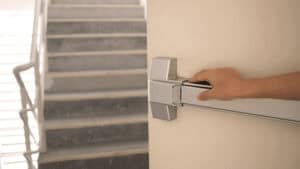
The Occupational Safety and Health Administration (OSHA) requires every workplace to provide a strict and unobstructed path to safety. Panic hardware plays a vital role in this regard. Also known as crash bars, panic bars, and push bars, during a crisis, panic hardware allows staff, visitors, and tenants to escape through fire doors and emergency exits without a key, simply by pushing on the door. The spring-loaded device automatically slides the latch open, allowing them to pass through unimpeded.
Buildings That Require Panic Hardware
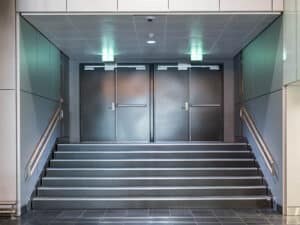
According to OSHA, every building designed for assembly, education, or hazardous activities must have at least two emergency exits operated by panic hardware. However, because they are durable and easy to use, panic bars are also frequently installed in spaces where they aren’t required, such as gymnasiums and auditoriums.
Panic Hardware Specifications
In order to comply with building codes, panic hardware has to be installed according to strict guidelines. It has to be installed on designated fire exit doors in the building, 34-48 inches above the floor or threshold. In addition, panic bars must be at least half the width of the doorway.
Types of Panic Hardware
There are several different types of panic bars. Depending on your situation, you may need to install one or all of them in your building.
- Rim. The most common type of panic hardware, used primarily on single doors. Contains a bolt that extends out from the bar and latches into the doorframe. All equipment is surface mounted. It can be installed on any type of door (wood, steel, glass, etc.) without much effort or expense.
- Mortise. Instead of protruding from the bar, the latch bolt is installed inside the door itself so it extends out from the edge. Though they can be used on single doors, they are more common in double doors.
- Vertical Rode. Rather than bolts that extend out from the panic bar, a rod or cable system has bolts that extend up into the door jamb and down into the floor. Because they provide multiple latch points, rod and cable systems are typically found on double doors or in buildings that require greater security.
- Multipoint. Combines a rim system with a rod device for enhanced security and wind resistance.
There are also two varieties of push bars. Touchpads are wide bars that retract into the housing mounted on the door’s surface. Crossbars, on the other hand, are thin and narrow, for spaces that prefer a minimalist appearance. When pressed, they swing down to release the latch.
Locks and Security Hardware
Any door with panic hardware cannot contain a locking device, such as a chain or padlock, which would prevent someone from opening it. However, for security reasons, certain types of internal locks are allowed in doors with delayed egress or controlled egress.
When someone attempts to open a door with a delayed egress lock, it triggers an alarm ‒ a security measure designed to stop thieves from making an unauthorized exit. The alarm lasts fifteen to thirty seconds, after which the door unlocks and allows the person through.
The same thing happens on doors with controlled exit locks, except that the door does not unlock automatically after the alarm sounds. Instead, a staff member has to come and open it manually. Controlled exits are common in assisted living facilities, where there is a danger residents might wander away and injure themselves.
Installing Panic Hardware in Your Business
Whether you need to install panic bars on a new door or upgrade your existing hardware, Vortex technicians can help. Our innovative solutions minimize time and expense, allowing us to bring your doors up to code on time and on budget. Contact us today to learn more about our outstanding products and services!
Want to SHARE this?
Categories

Popular Links
Related Content
Fully Certified and Accredited Commercial Door Experts