ADA Low-Energy Opener Requirements: What You Need to Know
February 4, 2026 | Commercial Doors
For modern businesses, understanding ADA low-energy door opener requirements is a practical and legal necessity. Installing openers not only helps you avoid costly fines, it also creates an inclusive environment for customers, whether they’re in a wheelchair, pushing a stroller, or carrying a bag of groceries. To ensure your building remains accessible to everyone, this blog breaks down ADA guidelines regarding low-energy door operators ‒ reviewing their specifications, installation, and maintenance tips ‒ as well as the reasons why the ADA is an important concern for large and small businesses alike.
Why ADA Door Compliance Matters
The Americans with Disabilities Act (ADA) was signed into law by President George H. W. Bush back in 1990. One of its provisions requires every business that serves the public to make reasonable accommodation for people with limited mobility. Because doorways control access to buildings and shared spaces, they’re a particular concern for businesses who want to avoid trouble with the Department of Justice, the agency responsible for enforcing the ADA.
Current ADA guidelines require that at least sixty percent of a building’s public entrances be equipped with either a fully automatic or low-power door opener, to ensure people with wheelchairs, scooters and walking aids can access it. Failure to comply can result in fines of up to $75,000 for the first violation and $150,000 for each subsequent violation. Companies may also have to worry about damage to their reputation, making them seem unsympathetic to their less able-bodied customers.
What is an ADA Low-Energy Door Opener?
A low-energy door opener, also known as a low-energy door operator, is a mechanical device that opens and closes doors on behalf of users. For businesses with moderate to heavy foot traffic, they’re a popular and cost-effective solution that enables you to promote access and comply with ADA regulations. If you’re not certain whether your opener is low-energy, look for these common features:
- Knowing Act. In order to activate a low-energy door, users are required to take a deliberate action such as pushing a button or scanning a keycard, referred to in the industry as a “knowing act.”
- Dual Operation. Unlike other types of powered doors, low-energy doors are mixed use, meaning they can be opened manually or mechanically.
- No Guide Rails. Low-energy doors are equipped with an actuator, a pneumatic, motor-driven, or hydraulic arm that extends to open the door. These devices ensure the door moves slowly and smoothly, eliminating the need for rails to prevent uncontrolled swinging.
Low-energy doors come in three configurations, depending on your needs. You can choose:
- Single Door. The opener is attached to a single door that swings inward or outward when activated.
- Double Door. Two openers are attached to a pair of swinging doors, allowing them to open simultaneously when the user activates them.
- Double Egress. A pair of doors, wired to the same button, that open in different directions when activated – to accommodate two-way traffic within your building.
Low-energy operators are an easy way to comply with ADA guidelines. Because they can be retrofitted onto a standard door at relatively low cost, they are a simple solution for business owners and property managers looking for ways to make their entrances more accessible.
Low-Energy vs. High-Energy Openers
When businesses, institutions, and organizations need to automate their doors, they have a choice between high-energy and low-energy operators. High-energy openers are normally found in busy areas, such as main entrances, where doors need to open and close frequently in order to accommodate large numbers of people. These units are fully automatic, controlled by sensors that detect motion and activate the door when a user approaches. For anyone who can’t decide whether they need a low-energy or high-energy operator, here are the key differences.
- Speed. High-energy units are significantly more powerful than their low-energy counterparts, capable of opening a door in 1-3 seconds.
- Activation. Because they’re controlled by motion sensors, high-energy systems open without user input. Low-energy systems, on the other hand, remain closed until intentionally activated.
- Installation. One of the advantages of low-energy openers is they can be retrofitted onto existing doors. Installing a high-energy opener, on the other hand, normally requires an overhaul of the existing doorframe and support structure.
Despite their differences, both low and high energy units come equipped with robust safety systems. Low-energy systems typically rely on overhead or door-mounted motion sensors to prevent doors from closing on people. Because they operate with greater force, high-energy systems have more elaborate safety precautions. In addition to motion and presence sensors, many have pressure sensitive edges that halt the door whenever someone or something is standing on them.
Power-Assisted Doors
Sometimes confused with low-energy openers, power-assisted doors aid users but don’t automate doorways. Instead, users trigger them by pushing or pulling the door handle. As the door swings open, its internal sensors detect movement and trigger the operator, which swings the door open the rest of the way. Though power-assistance reduces the effort necessary to open heavy doors, they require more effort from the user, making them a less popular choice for companies seeking to improve accessibility.
Where are Low-Energy Door Openers Used?
Low-energy door openers are a versatile solution for businesses that interact with the public. Thanks to their simple design and ease-of-use, they’re found in a wide range of locations, including:
- Airports
- Apartment Complexes
- Bus Terminals
- City Halls
- Convention Centers
- Courthouses
- Factories
- Hospitals
- Hotels
- Office Buildings
- Post Offices
- Restaurants
- Retail Stores
- Schools
- Shopping Malls
- Supermarkets
- Theaters
- Warehouses
Because low-energy door openers have such a broad range of applications, they’re a flexible solution for industries seeking to improve compliance, convenience, and safety. Besides facilitating the movement of staff, visitors, and tenants, low-energy openers:
- Improve Hygiene. Though many low-energy systems are operated by pressing a button, touchless configurations do exist. A popular option for hospitals, they enable smooth movement while limiting the spread of germs.
- Reduce Congestion. By making it easier to transition between different parts of your facility, low-energy systems help manage the flow of people through public spaces such as airports, convention centers, and government buildings.
- Enhance Security. When connected to your access control system, low-energy openers can be used to restrict entry to sensitive areas, such as storerooms, servers, and laboratories, without hindering your staff.
In order to integrate your opener with your access control equipment, you’ll need to install either an electric strike or motorized latch retraction system. When activated, electric strikes release the latch while motorized systems pull it flush with the door. While both are convenient, motorized systems require less effort to operate, making them a popular choice for locations concerned about ADA compliance.
ADA Door Requirements
The purpose of the ADA is to remove barriers to entry and ensure every American can access public spaces without difficulty. While installing a low-energy operator is a crucial first step, there are several other rules doors must follow to meet ADA regulations.
- Width. The doorway must have at least 32-inches of clearance.
- Thresholds. Must be no higher than 1/2 inch. Any threshold higher than 1/4 inch must be beveled.
- Opening Force. Applicable doors cannot require more than five pounds of force to open.
- Closing Speed. It should take the door no less than five seconds to move from the 90 degree open position to the 12 closed position.
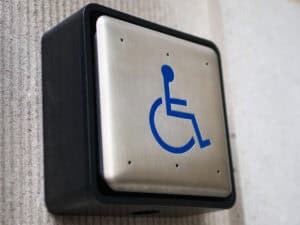
- Button Height. Buttons must be placed outside the door swing, 38-48 inches above the floor. Users must be able to activate them with one hand, using no more than five pounds of pressure.
- Maneuvering Space. There must be 48 inches of open space on the push side of the door and 60 inches on the pull side, measured from the door latch.
- 10-Inch Requirement. Manually operated swing doors must have at least ten inches of smooth surface on the push side, so users won’t catch their mobility aids while they move through the doorway.
Unless every public entrance in your building is ADA-compliant, any accessible entrance must be labeled with the International Symbol of Access ‒ often referred to as the wheelchair symbol. In many cases, the symbol is placed directly on the button and accompanied by the phrase “Push to Open” or “Press to Operate Door,” so it can be readily identified by users.
Tips for Installation and Maintenance
Though typically capable of withstanding thousands of opening and closing cycles, low-energy operators cannot function without reliable maintenance. Because a breakdown can result in possible fines and interruptions, property owners need to take steps to ensure their openers perform as expected. For your own protection:
- Schedule an inspection at least once a year
- Hire a technician familiar with ADA rules
- Record inspection dates, repairs, and part replacements
Vortex Doors inspects, troubleshoots, and maintains all types of low-energy door openers. Our experience allows us to identify worn parts before they break down, making sure that your doors continue to meet ADA requirements without any interruptions or difficulties. Contact us today for more information or to schedule an appointment with one of our local service centers.
Want to SHARE this?
Categories
Popular Links
Related Content

Fully Certified & Accredited Commercial Door Experts