Types of High-Speed Doors and Their Advantages
March 25, 2026 | Commercial Doors
 As their name suggests, high-speed doors (also known as high-performance doors) are door systems that move at accelerated speeds. While standard commercial doors move at around six inches a second, high-speed doors open and close at least three times faster. Some units move up to 100 inches a second!
A few seconds might not seem like much, but given the size of standard warehouse doors (10×10 feet), those seconds add up. Installing a high-speed door lowers temperature exchange by a few minutes each day, significantly reducing the amount of energy your business consumes over time.
There are several types of high-speed doors and they’re found across multiple industries, everything from pharmaceutical warehouses to food and beverage plants. Their fast cycle times limit your exposure to dust, debris, and outside temperatures, making them an invaluable tool in locations that rely on clean working conditions and strict temperature control.
When To Use High-Speed Doors
High-speed doors are a versatile solution, with specific applications for commercial organizations that require tight control over working and storage conditions. Companies install high-speed doors when they’re looking for ways to improve:
- Productivity. Fast cycle times streamline traffic flow, allowing goods to move through your facility in a smooth and timely manner.
- Efficiency. By minimizing exposure to outside elements, high-speed doors make it easy for climate systems to maintain stable temperatures in sensitive areas.
- Safety. Built-in safeguards prevent high-speed doors from closing when people, objects, and vehicles are passing through.
- Durability. High-speed doors are made from high-grade steel, aluminum, or polycarbonate, which allows them to function for years in demanding environments without major repairs.
- Costs. While all doors require regular maintenance in order to function, high -speed doors experience little wear and tear thanks to their reinforced components and materials.
Some of the most common locations that benefit from high-speed doors include:
- Food Preparation and Processing Plants. Short cycle times prevent contamination, helping businesses comply with state and federal health codes.
- Cold Storage Facilities. High-speed doors minimize temperature loss, allowing you to cut power consumption while keeping stockrooms cool.
- Cleanrooms and Laboratories. By opening and closing quickly, high-performance doors help maintain sterile environments.
- Industrial and Manufacturing Centers. In busy workplaces, high-speed doors improve logistics and internal supply chains.
- Warehouses. Installing high-performance doors in loading docks facilitates shipments while providing strong barriers against intruders and inclement weather.
- Airports. Rapid-closing doors allow pilots and workers to move aircraft and equipment in and out of airplane hangars without disrupting their internal environment.
Types of High Speed Doors
High-speed doors are categorized based on their materials and operation. While they all deliver the same core benefits, each type has its own particular strengths.
High-Speed Fabric Doors
Most high-speed fabric doors are made from tightly woven polyester coated with PVC. Their unique design provides strength and flexibility, allowing them to endure high winds and poor weather without ripping or tearing. Thanks to their lightweight design, they have the fastest cycle times of any high-speed door. They’re also the most affordable high-performance unit on the market, and the easiest to repair.
High-Speed Rubber Doors
High-speed rubber doors are constructed from multiple layers of heavy-duty nitrile butadiene rubber, reinforced with polyester weave for added strength and durability. While relatively lightweight, these units operate well in extreme weather and high wind pressure. This resilience makes them a relatively low-cost unit with minimal maintenance requirements.
High-Speed Metal Doors
Made from steel or aluminum, high-speed metal doors are long-lasting and reliable. While not the fastest units on the market, they are still capable of moving at speeds up to 80 inches per second. Known for their superior durability, metal high-speed doors are both impact and fire resistant. They can survive a direct collision with a forklift or pallet jack without cracking, bending, or denting.
At the same time, their fireproof material blocks smoke and flames, an important safety feature for manufacturing centers, particularly ones with industrial chemicals or flammable products. What’s more, most metal doors are galvanized or powder-coated, allowing them to operate for years in rainy, humid, and coastal conditions without corroding. While these properties make metal doors comparatively expensive, they also keep their lifetime costs relatively low.
Folding High-Speed Doors
These doors consist of a series of interlinked panels that stack on top of one another when you open them. Though they can’t cycle as quickly as some of the other high-speed doors on the market, their simple, compact design makes them well-suited for spaces with limited headroom. Normally made from steel or aluminum, they are one of the few units that can safely incorporate windows, letting more natural light into your workplace.
Sectional High-Speed Doors
These doors are also made from a series of hinged, interlocking slats that lift and slide back along the ceiling as they open. Because they move vertically, they help businesses maximize floorspace. Normally constructed from steel or aluminum, their structure makes it easy to customize their level of insulation by adding polystyrene or polyurethane foam between the slats, without greatly increasing the amount of space they take up. Some models even incorporate windows, for improved visibility and lighting.
Rolling High-Speed Doors
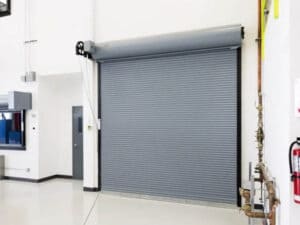
Rolling high-speed doors contain a number of interlocked panels or slats, similar to sectional doors. These slats form a flexible curtain that, when opened, coils around an axle housed above the door. Because the door retracts into a compact container, they’re a convenient solution for businesses that need to maximize both floor and ceiling space.
Sliding High-Speed Doors
Sliding high-speed doors open horizontally, enabling you to take advantage of their full height as soon as they’re activated. Opening to the side makes them a popular choice for locations where lack of headroom makes it difficult to accommodate vertical door designs. It also permits tall vehicles, like high-mast forklifts, to travel quickly through your facility.
How to Choose the Right High-Speed Door
With so many options, selecting the right high-speed door can seem daunting. Before making a decision, consider the following factors, to make sure your choice matches your needs as closely as possible.
- Priorities. All high-speed doors minimize air exchange, but are there any other considerations? Security? Hygiene? Noise reduction? Some industries have specific operational requirements certain types of doors might not be able to meet.
- Location. Will the door be located indoors or outdoors? External doors need to be durable, to withstand harsh weather conditions, while internal doors don’t need to be as strong.
- Environment. In addition to the natural environment, consider your working environment as well. Do you need to accommodate vehicles or foot traffic? Do you work with corrosive chemicals? Are there specific safety or industry standards you need to follow?
- Budget. Since costs vary depending on each door’s material and structure, take a moment to determine how much you can afford to spend. Don’t forget to account for maintenance costs. Strong doors typically have higher upfront costs, but lower long-term ones.
Because high-speed doors are precision-engineered, measure your entrance carefully to determine how much room you have to work with. Rolling doors are compact, but sectional doors need enough space along the ceiling to accommodate the door’s height, which might make them impractical for locations with extensive ductwork. Likewise, sliding doors require a long stretch of clear space on each side of the door, equal to half the door’s width.
High-Speed Door Repair and Maintenance
Regardless of which type of door you choose, it can’t function without reliable support and routine service. Vortex’s service teams help identify potential problems early, before they escalate and cause serious downtime. By inspecting and repairing parts proactively we help prolong your door’s lifespan while lowering its lifetime costs. Don’t let a malfunction disrupt your business. Contact us today to learn more about our high-speed door service plans.
Want to SHARE this?
Categories
Popular Links
Related Content

Fully Certified and Accredited Commercial Door Experts